
The Short Answer
No, a commercial overhead door is not just a scaled-up version of your residential garage door. They use different counterbalance systems, heavier-gauge materials, different opener hardware, and they need maintenance far more often because they cycle so much more. If someone in your house is arguing that "a door is a door," you can settle it right here.
Why They're Built Differently
A residential garage door on a house is built to open and close a handful of times a day, usually under a torsion spring system sized for one or two sections of panel. A commercial door on a warehouse, shop, or fire station bay might cycle dozens or even hundreds of times a day. That difference in use changes almost everything about how the door is engineered:
- Counterbalance systems: Commercial doors often use heavier torsion springs rated for thousands more cycles, or in larger bays, a drum-and-cable system paired with a torsion shaft built to carry more weight safely.
- Track and hardware gauge: Commercial tracks, hinges, and rollers are typically heavier steel than residential parts, because they're absorbing more wear and often larger, heavier door sections.
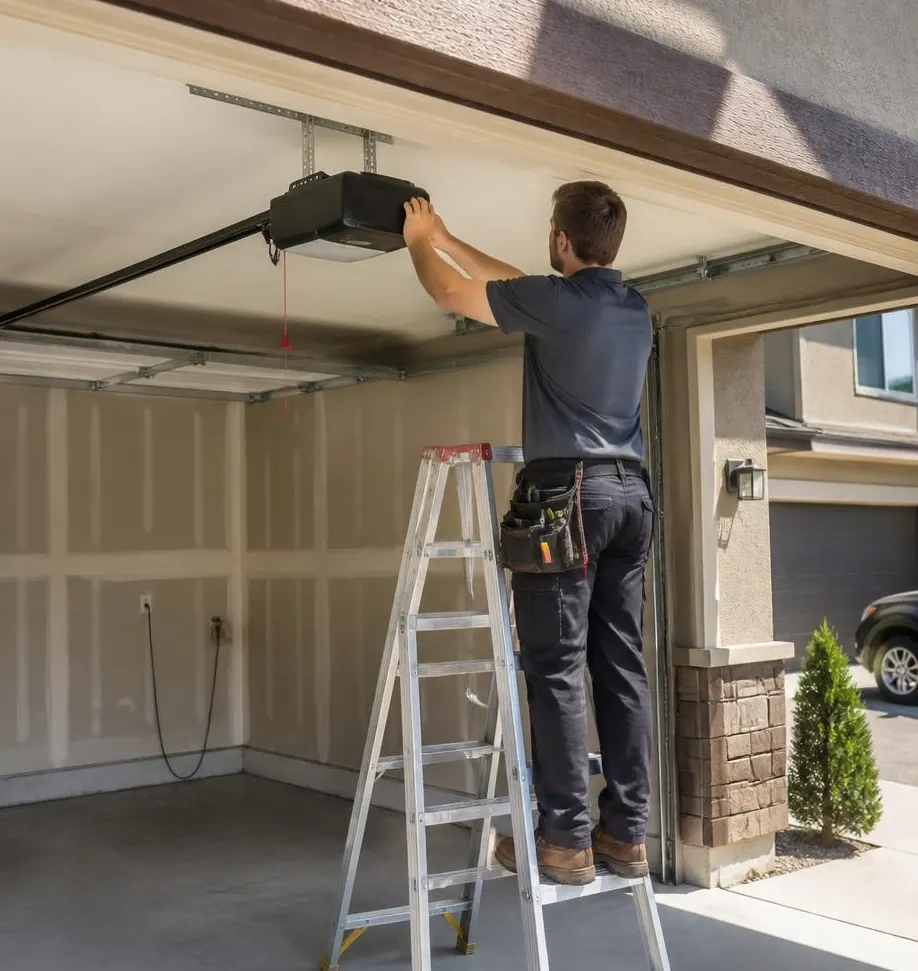
- Opener type: Residential openers are chain, belt, or screw-drive units mounted to a single rail. Commercial doors frequently use jackshaft operators mounted beside the door, or heavy-duty trolley operators built for constant use, sometimes with separate safety edges and photo-eye setups required for repeated vehicle or pedestrian traffic.
- Door construction: Commercial sections are often steel, aluminum, or insulated sandwich panels in wider spans, sometimes with wind-load reinforcement built into the panel rather than added after the fact.
Where the Coastal Climate Changes the Math
In this part of Florida, both residential and commercial doors face the same enemies — just at different scales. Salt air drifting in from the coast accelerates corrosion on hinges, tracks, and spring coils faster than it would inland. Humidity swells wood trim and can warp lightweight panels. Afternoon downpours mean water intrusion at the bottom seal is a daily event for months at a time, not an occasional storm problem.
Commercial doors also have to meet wind-load requirements for the areas they're installed in, just like residential doors do, but the stakes are higher: a large bay door failing during a storm can mean a building envelope breach that damages inventory, equipment, or vehicles inside. That's why commercial doors in wind-exposed or coastal-facing buildings are often specified with reinforced struts, heavier end hardware, and astragal seals designed to resist wind-driven rain.
Maintenance: Why "Set It and Forget It" Doesn't Work
A homeowner can often get away with checking their garage door twice a year. A business running a door dozens of times a day cannot. High-cycle use means springs, rollers, and cables wear out faster — not because the parts are bad, but because they're doing more work.
What commercial door maintenance typically includes:
- Checking spring tension and cycle life more frequently, since high-use doors hit their rated cycle count much sooner than a residential door would
- Inspecting and lubricating rollers, hinges, and tracks on a set schedule rather than waiting for a problem
- Testing safety reversal, photo eyes, and edge sensors — critical where forklifts, delivery trucks, or employees pass through regularly
- Checking weatherseals and bottom astragals for salt-air corrosion and water intrusion, especially after storm season
- Verifying that the opener's force settings haven't drifted, which can happen as springs lose tension over heavy use
Skipping this on a residential door might mean a noisy opener or a slow close. Skipping it on a commercial door can mean a jammed bay blocking deliveries, a dropped door causing property damage, or a safety incident with far more liability attached.
The Practical Differences You'd Actually Notice
If you've ever compared the two side by side, a few things stand out immediately:
- Commercial doors are usually wider and taller, built for vehicle clearance rather than a single car or two
- The springs are often mounted differently — torsion shafts with multiple springs instead of one or two
- The opener is frequently mounted to the side wall (jackshaft style) rather than overhead, especially when ceiling clearance is tight for trucks or equipment
- Panel materials lean toward steel or insulated composite rather than the lighter aluminum or wood sometimes used residentially
None of this means a commercial door is automatically more complicated to live with — it just means it's engineered for a different job, and it needs attention on a different schedule.
When to Call Precision Garage Door of Panama City
Whether it's a residential door that's started sagging after a humid summer or a commercial bay door that's cycling rough after heavy daily use, the warning signs are worth acting on early: grinding noises, uneven closing, visible rust on hardware, or an opener that struggles more than it used to. Our technicians handle both Garage Door Maintenance & Tune-Up for businesses that need a scheduled inspection program, and Emergency Garage Door Repair for a bay door that's stuck mid-cycle and holding up operations. We check spring tension, hardware condition, and weatherseal integrity with coastal wear in mind, not a generic checklist.
If you're in Panama City, Panama City Beach, Lynn Haven, Springfield, Callaway, Parker, Cedar Grove, or Upper Grand Lagoon and you're not sure whether your door — residential or commercial — is due for a look, call Precision Garage Door of Panama City. We'll give you a straight answer, and you can go ahead and win that argument.