
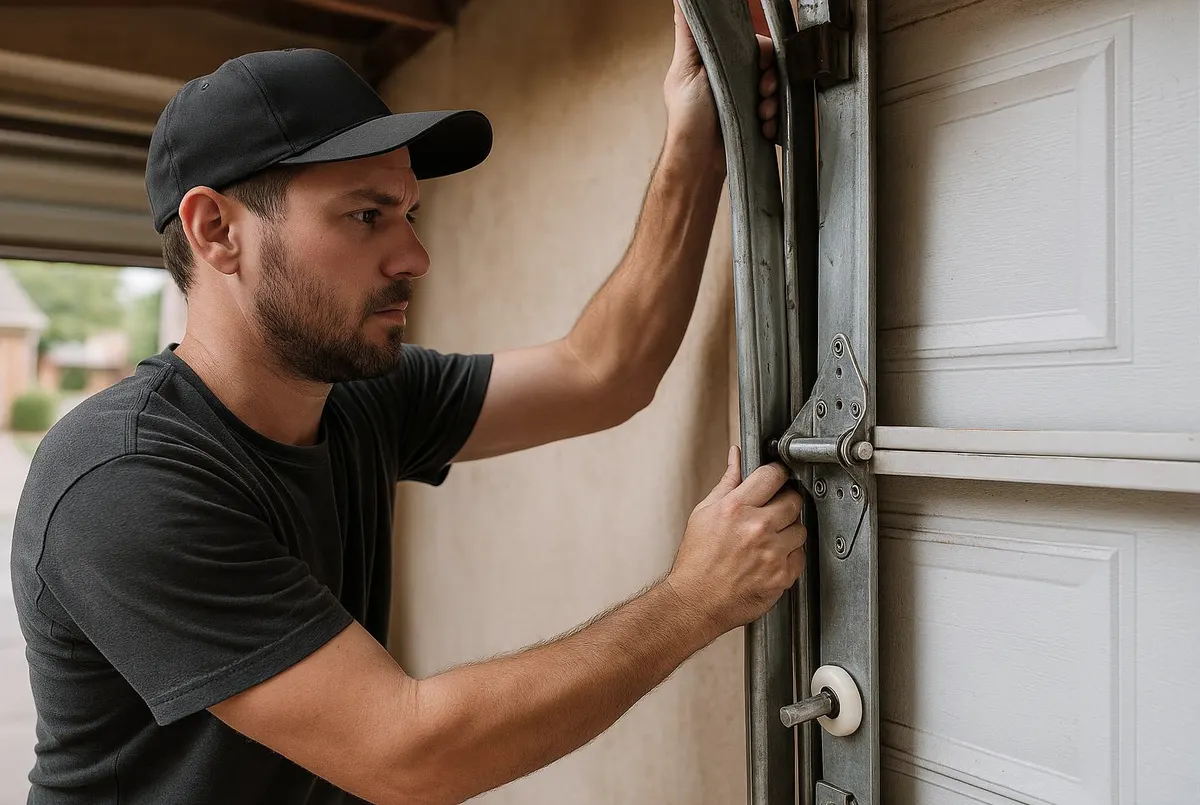
The Mistake: Assuming the Door Will Just Stop
Most parents and pet owners make the same assumption: if a child, dog, or cat is under a closing garage door, the door will sense it and reverse. That assumption is tempting because it's mostly true when the door is new and working correctly. The safety reversal system has been standard on residential openers for decades, so it feels like a given, like airbags or seatbelts. Nobody tests it because nobody thinks they need to.
The problem is that auto-reverse depends on two things working together: a pair of photo-eye sensors mounted a few inches off the ground on either side of the track, and a force-sensing mechanism in the opener itself. Either one can fail quietly, with no warning light, no error code, nothing that tells you the safety net is gone until the day you need it.
How It Fails, Specifically
In Bay County's climate, the photo-eye sensors are the more common failure point. They're small plastic units bolted to brackets near the bottom of the track, and they rely on a precise, unbroken infrared beam between the two sides. A few things knock that alignment off:
- Humidity and moisture swelling can shift wood-framed openings slightly over a season, just enough to tilt a sensor bracket out of true alignment.
- Salt air near the coast corrodes the mounting screws and brackets, so a sensor that was tight in spring can work loose by fall.
- A bumped sensor — a kid's bike, a cooler, a rake leaned against the wall — is the single most common cause of misalignment, and it's invisible unless you know to look.
The force-sensing side can also drift. Torsion springs lose tension gradually, and as they weaken, the opener has to work harder to lift the door. Some openers compensate by increasing motor force, which means the door takes more resistance before it decides to reverse. In the worst cases, a door that should stop on contact with a two-year-old's shoulder keeps pulling closed, because the force threshold crept up over months without anyone adjusting it back down.
How Bad It Actually Gets
A malfunctioning auto-reverse isn't a minor inconvenience. A standard garage door section weighs somewhere in the range of 130 to 400 pounds depending on material and size, and it's moving under motor force, not just gravity. For a small child, that's enough to cause serious crush injuries to the chest or skull. For a pet, it's often fatal, because animals don't understand the danger and will dart back under a closing door chasing a ball or a person.
Pinch points are the other quiet hazard. The sections of a sectional garage door fold against each other as it closes, and the gap between panels closes fast enough to take off a fingertip. Kids are drawn to put their hands exactly there because it's an interesting moving part at their eye level.
What Actually Prevents It
None of this requires replacing your opener. It requires a short monthly habit and a few fixed points of household discipline.
Test the Reversal Monthly
- Place a roll of paper towels or a 2x4 flat on the ground in the door's path.
- Close the door using the wall button or remote.
- The door should touch the object and reverse immediately. If it keeps pushing, stops without reversing, or hesitates, the force setting or the sensors need attention.
Also test the photo-eye directly: close the door, then wave your hand or a broom handle through the sensor beam about six inches off the floor. The door should stop and reverse the moment the beam breaks. If it doesn't react at all, the sensors are misaligned, dirty, or disconnected.
Control Who Can Operate the Door
- Mount wall-control buttons high enough that young children can't reach them — out of easy reach of a step stool is the practical test.
- Keep remotes off the coffee table and out of toy bins. Treat them like car keys, not like toys.
- If your opener has a smartphone app, use the activity log occasionally to see if the door is being operated at odd times by a curious kid who found a spare remote.
Reduce the Pinch and Crush Zones
- Add pinch-resistant panel covers if your door is an older model without them built in — most doors made in the last decade have rounded, finger-safe panel edges, but older doors often don't.
- Never let a pet lie down or sleep in the garage doorway track area, even when the door looks fully open; dogs especially like the cool concrete and shade there.
- Teach kids the rule plainly: never run under a garage door, moving or stopped, and never put hands near the track or the folding panel seams.
Account for the Local Climate
After any stretch of heavy afternoon downpours or a tropical system, walk out and visually check the photo-eye brackets for moisture intrusion or corrosion, and wipe the sensor lenses clean — salt residue and humidity film build up on the lens surface and can weaken the beam enough to cause intermittent failures. If your door has started feeling heavier to open by hand, or the opener strains and groans more than it used to, the spring tension has likely shifted and the auto-reverse force settings are probably out of calibration along with it.
When to Call Precision Garage Door of Panama City
If the paper-towel test fails, if the photo-eye doesn't react to a broken beam, or if the door feels noticeably heavier than it used to, don't try to recalibrate the force settings yourself — guessing wrong in either direction either disables the safety feature or makes the door unusable. Our Garage Door Maintenance & Tune-Up service includes testing and resetting auto-reverse force, aligning and cleaning photo-eye sensors, and checking spring tension so the numbers match what the opener expects. If a spring has already failed or the door won't move at all, our Garage Door Spring Repair team handles that safely, since torsion springs are under enough tension to cause serious injury if handled without the right tools.
If you have kids or pets in the house and haven't tested your door's safety reversal this year, call Precision Garage Door of Panama City today — we serve Panama City, Panama City Beach, Lynn Haven, Springfield, Callaway, Parker, Cedar Grove, and Upper Grand Lagoon, and we can usually get a technician out quickly to check it properly.